
Why “We Can Always Lower the Price Later” Can Be a Costly Strategy
One of the most common conversations we have with sellers goes something like this:
“We understand what you think the house is worth, but why don’t we start a little higher? We can always come down.”
I understand the thinking behind it. On the surface, it sounds reasonable.
But after selling real estate around Lake James for more than two decades, I can tell you that real estate rarely works that way.
The question we really need to be asking isn’t:
“What is the highest price we can put on the house?”
The better question is:
“What pricing strategy gives us the best chance of getting the highest possible sale price?”
Those are two very different things.
What Happens When You Start Too High?
There is now some pretty compelling data on this.
Redfin recently analyzed MLS sales from 2023 through 2025 and studied the relationship between pricing accuracy and time on the market.
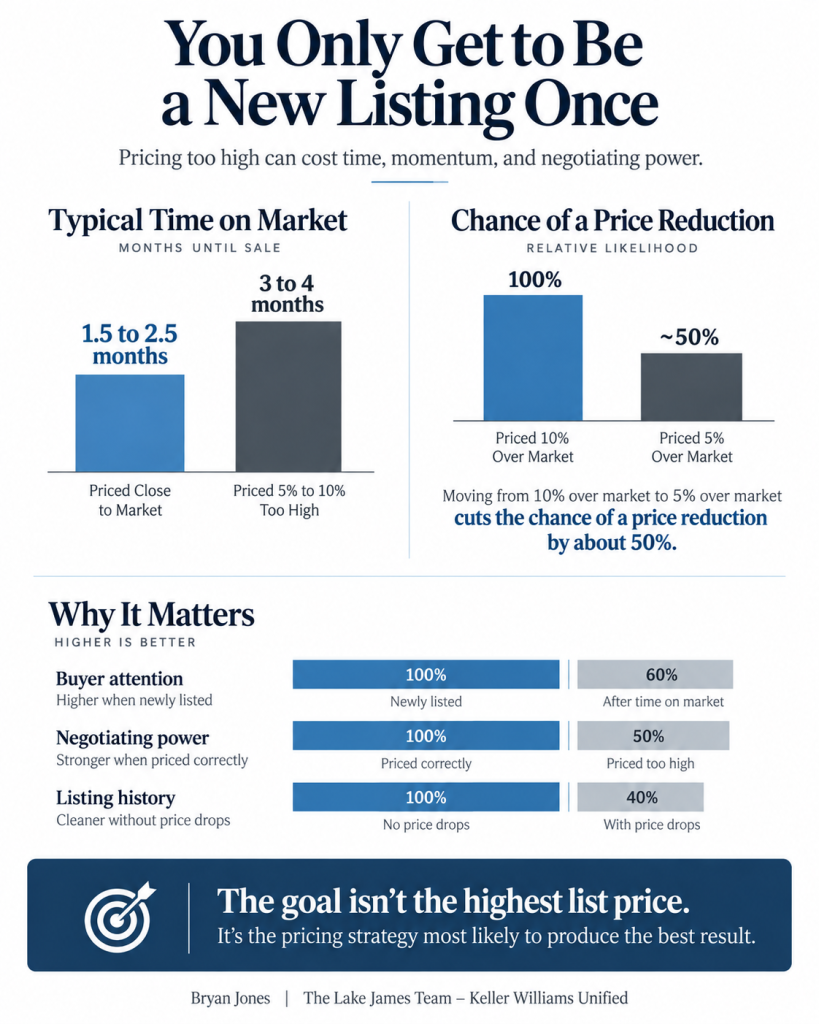
Their analysis estimated that accurately priced homes typically sold within roughly 1.5 to 2.5 months.
Homes priced 5% to 10% above the market spent approximately 3 to 4 months on the market.
That is a significant difference.
And from our perspective as Realtors, the problem isn’t simply having to wait longer.
Redfin also found that reducing the degree of overpricing from 10% above market to 5% above market reduced the probability of eventually needing a price reduction by approximately 50%.
That matters because reducing the price later is not necessarily the same thing as pricing the home correctly from the beginning.
You Only Get to Be a New Listing Once
This is probably the point I stress most with sellers.
You only get to be a new listing once.
The first few weeks a home is on the market are usually when buyer interest is strongest.
Buyers are watching new listings.
Agents are sending new properties to their clients.
The real estate websites are sending alerts.
People are wondering whether someone else is going to buy the house before they have a chance to see it.
That is when we want the market paying attention to your property.
Zillow has made the same point, noting that the first weeks on the market are often the most valuable because buyer interest tends to be strongest when a listing is new.
If we spend that period trying a price the market doesn’t support, we cannot get those days back.
Eventually, the seller may reduce the price to where the home probably should have been listed originally.
But now the buyer sees something different.
They see:
75 Days on Market
Price Reduced
And instead of asking:
“How quickly do we need to make an offer?”
they start asking:
“Why hasn’t this sold?”
We see this happen all the time.
And that creates a very different negotiating environment for the seller.
A Price Reduction Has a Cost
Redfin describes this as the stigma associated with a price-drop history.
Their research makes an interesting point.
Imagine two identical homes.
One lists at $450,000.
The other lists at $500,000, sits on the market and eventually reduces to $450,000.
Logically, you might think buyers would treat them the same because they are now both $450,000.
They don’t necessarily do that.
The house that started at $500,000 now carries a history. Buyers may interpret the reduction as evidence that the seller is becoming more motivated or that the original market response was weak.
Redfin’s analysis of single-family MLS sales from 2023 through 2025 found an association between having a price reduction and a roughly 5.4% lower sale price, even after controlling for predicted property value, property characteristics, market conditions, days on market and other factors.
That does not mean every seller who reduces their price is going to lose 5.4%.
It does mean that the strategy of “we can always reduce it later” is not necessarily harmless.
Could Starting High Ever Work?
Absolutely.
And I think this is an important distinction.
We are not suggesting that every property should be priced conservatively.
There are certainly times when Fletcher and I believe a property is unique enough that it makes sense to push the market.
Academic research has even found evidence of an “anchoring effect” in real estate. A higher asking price can sometimes influence negotiations upward.
One study published in the Journal of Economic Behavior & Organization analyzed more than 14,000 residential transactions and found that higher initial asking prices were associated with slightly higher selling prices.
But look at the size of the benefit.
For the average property in the study, pricing 10% to 20% above value increased the final sale price by only about $117 to $163.
That is not a typo.
The researchers did find an anchoring effect.
It just wasn’t very large.
So yes, there are situations where pushing the price makes sense.
We do it.
But there is a big difference between strategically testing the upper end of a reasonable range and simply putting an unrealistic number on a property because that is the number the seller hopes to get.
Lake James Is Even More Price Sensitive
This is where Lake James becomes a little different from many real estate markets.
We don’t have thousands of nearly identical houses changing hands every month.
Every property here is different.
Waterfront.
View.
Water depth.
Dock.
Walk to the water.
Lot size.
Topography.
Community.
Camp Lake James membership.
Short-term rental eligibility.
Quality of construction.
Renovations.
Orientation.
Mountain views.
Privacy.
All of those things matter.
That is why pricing real estate on Lake James is not as simple as looking at the price per square foot of three nearby sales.
We spend a lot of time trying to understand what makes one property more valuable than another.
And buyers at Lake James are generally pretty sophisticated.
Many of them have been looking at the lake for months, and sometimes years. By the time they walk into a $1.5 million, $2 million or $3 million lake home, they usually know what else is available.
They have been watching Zillow.
They have been watching Realtor.com.
They have seen the other houses.
They know when something has been sitting on the market.
They know when the price has been reduced.
So we cannot simply add hundreds of thousands of dollars to an asking price and assume buyers won’t notice.
They notice.
We Aren’t Trying to Give Your House Away
I think this is worth addressing because I understand why sellers sometimes feel this way.
When a Realtor recommends a lower price than a homeowner hoped to hear, it can be easy to think:
“They just want to price it low so they can sell it quickly.”
A good Realtor should be doing exactly the opposite.
When Fletcher and I recommend a price, our goal is not to determine the lowest price that will get the house sold.
And it is not simply to come up with the highest number a buyer might possibly pay.
Our job is to recommend the pricing strategy that we believe gives our seller the best chance of getting the best overall result.
Sometimes that means pushing the market.
Sometimes a property is unique enough that there simply aren’t good comparable sales.
In those situations, we may recommend testing the upper end.
But there needs to be a reason behind the number.
There is a difference between:
“The comparable sales support around $1,500,000, but this property has an exceptional view, better waterfront and superior privacy, so we believe testing the upper end of the range is justified.”
and:
“I really want $1,900,000, so let’s just see what happens.”
Those are two completely different pricing strategies.
The Goal Isn’t the Highest List Price
Anyone can tell a seller what they want to hear.
Anyone can give a homeowner the highest suggested list price.
That part is easy.
The harder part is determining the price that will create enough interest to bring the best buyers to the table while still protecting the seller’s upside.
When we are representing a seller, the situation we want is not one buyer negotiating against us after the house has been sitting on the market for 120 days.
We would much rather have two buyers negotiating against each other during the first few weeks.
That is where the seller has negotiating power.
After more than two decades selling real estate around Lake James, there is one lesson I have seen play out over and over again:
The market eventually determines the value of the property.
Our job is to put the seller in the strongest possible position when the market makes that decision.
Bryan Jones
The Lake James Team – Keller Williams Unified
LakeJames.com